
Design
Why your proposals look homemade (and how to fix it in a day)
By the Bidas team · June 4, 2026 · 4 min read
A facilities director comparing three janitorial bids can't inspect your work before signing. What she can inspect is your documents — and she will treat a sloppy proposal as a preview of sloppy work. That's unfair, and it's also how the game is played. The good news: the things that make a proposal look homemade are a short, fixable list.
The six tells
- Default fonts. Calibri at 11pt says “I opened Word and typed.” So does Times New Roman at 12. Nobody chose those fonts; they just happened.
- A mistreated logo. Stretched to fit, pixelated from a screenshot, or floating with a white box behind it on a colored header.
- Walls of text. Paragraphs with no headings, no lists, no hierarchy — the reader's eye has nowhere to land.
- Pricing as prose. “We would charge $2,400 monthly for the above” buried mid-paragraph, or worse, a pasted screenshot of a spreadsheet.
- Broken pages. A table header orphaned at the bottom of a page, a section title alone above a page break, margins that drift from page to page.
- The filename.
proposal_final_FINAL2.docxarrives as an attachment and tells the client exactly how the sausage was made.
Why it happens
None of this is a character flaw. Word processors are writing tools, not document design tools — they hand you a blank page and fifty ways to go wrong, then make page breaks your problem. You're running a service business, not a design studio. The fix is not becoming a designer; it's refusing to start from a blank page ever again.
The one-day fix
Morning: pick a system, not a file
Choose a template with a locked structure — cover, letter, credentials, scope, pricing table, terms, signature — and commit to filling it in rather than laying anything out. Structure is where professionalism actually comes from. This is the entire premise of Bidas: five template families, each a complete multi-page document where the layout decisions are already made.
Midday: set your palette once
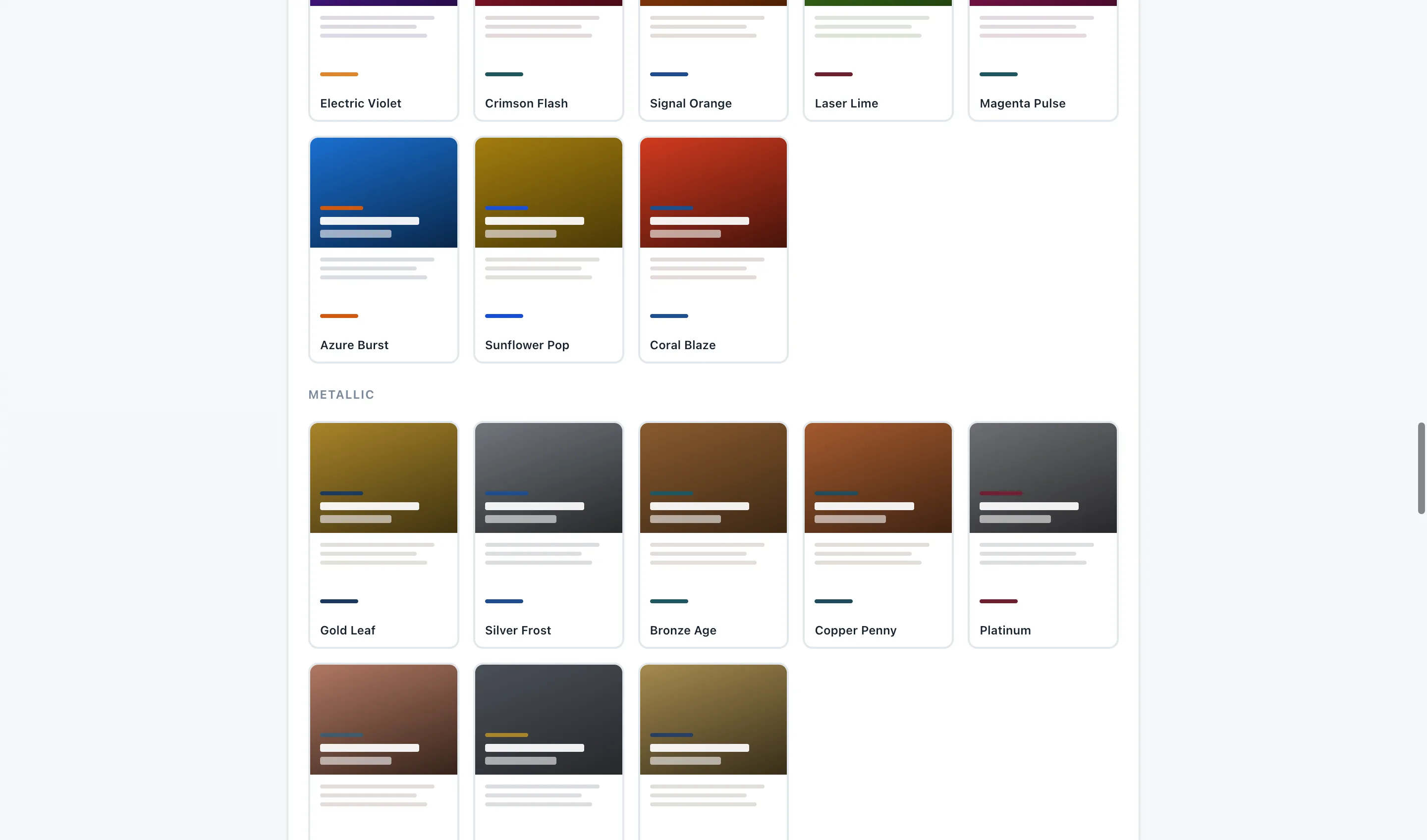
One accent color drawn from your logo, neutral dark text, one or two fonts at most. Save the combination and never revisit it. One hundred named themes in Bidas exist precisely so this decision takes minutes, and switching themes per proposal stays safe because every theme is verified against every template.
Afternoon: rebuild your pricing as a table
Take your last proposal and move every number into a line-item table: description, quantity, unit price, total. Add tax as its own row. Show any discount as a visible row too — it reads as generosity, not desperation. Then export to PDF and flip through it looking only at page breaks: no orphaned headings, no clipped tables, no section title stranded at the bottom of a page.
Save it as your starting point
The last step is the one that pays forever: keep that rebuilt proposal as the template for the next one. Duplicate it, swap the client, adjust the scope, send. Your second professional-looking proposal takes a tenth of the effort of the first — and by the fifth, the “homemade” version of your business no longer exists.
Put it to work on your next proposal
Bidas builds the structure, design, pricing math, and e-signature into one desktop app — free for your first three proposals each month.
Download free