
Proposal craft
The 7 sections every winning proposal has
By the Bidas team · May 12, 2026 · 5 min read
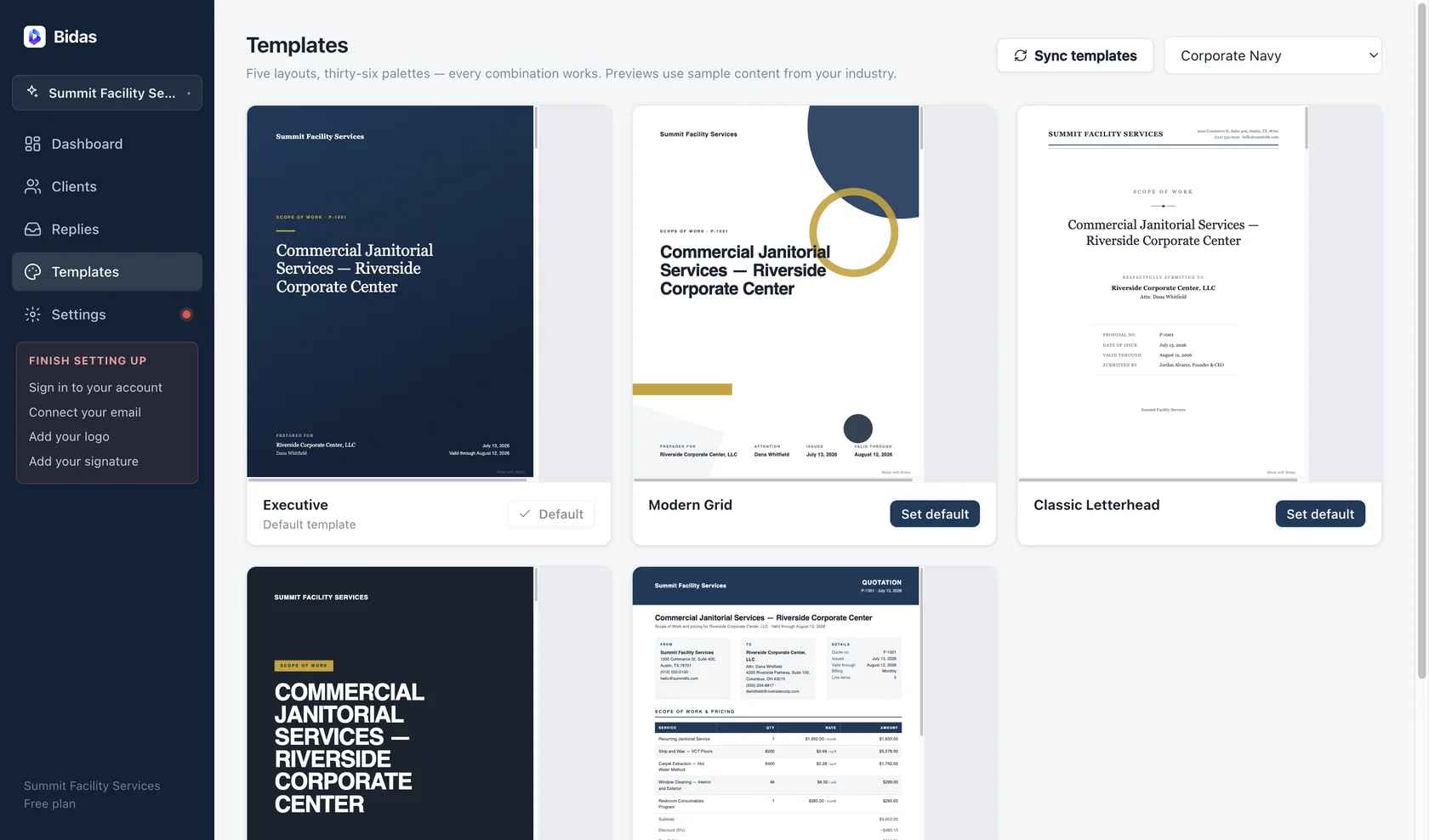
Most proposals don't lose on price. They lose because the reader can't find what they're looking for in the first ninety seconds. Facility managers, property directors, and business owners all skim proposals in roughly the same pattern — and the proposals that win are the ones whose structure matches that pattern. Here are the seven sections, in order.
1. A cover with their name on it
The cover is not about you. A winning cover carries the client's name, the project or property it addresses, the date, and a proposal number — not a full-page photo of your team. When a property manager forwards your proposal to their boss, the cover should make it unmistakable which vendor and which building it concerns. Add a validity date here and you've planted the first seed of urgency.
2. A leadership letter that proves you listened
One page, signed by a person. Three paragraphs: their situation as you understand it, your approach to it, and what happens next. This is the only section most decision-makers read word for word, and it's where they decide whether the rest is worth their time. Write about their problem longer than you write about your company. If your letter could be pasted into a proposal for any other client unchanged, rewrite it.
3. Credentials that answer their specific worry
Credentials are not a brag page — they're a risk page. The reader is asking: what happens to me if I hire you and it goes wrong? Answer with proof matched to their fear: years in business, similar properties served, insurance carried, certifications held, references available. A janitorial company bidding a medical building leads with healthcare-adjacent experience and insurance limits, not a list of every client since 2009.
4. Scope cards that leave nothing to argue about
Give each service its own numbered card: what's included, how often, and — just as important — what's excluded. Numbering matters more than it seems: it lets the client write “question about item 4” instead of “question about the cleaning part,” and it turns vague scope into a checklist both sides can point at later. Most contract disputes are scope ambiguities that were visible on day one.
5. An investment summary they can scan
One page, one table. Per-line totals that tie back to the scope cards, any discount shown explicitly (visible discounts close deals), tax itemized, and a total in a size nobody misses. For multi-year agreements, show the year-by-year table with escalation already calculated — a client who can see year three's number trusts you more than one told to expect “a modest annual adjustment.” Never bury your total inside a paragraph.
6. Terms that protect both sides
Payment terms, scheduling, cancellation notice, and the validity window. Terms written plainly signal that you've done this before. The validity date does double duty: it protects you from old pricing being accepted next year, and it gives the client an honest reason to decide this month.
7. A signature page that makes yes one step
Every extra step between “we want this” and a signed agreement costs you deals. The signature page should ask for a name, a signature, and a date — nothing else. If you're sending electronically, a hosted link with a typed name, drawn signature, and a recorded timestamp and IP address beats print-sign-scan in both speed and legal weight.
The order is the argument
Each section answers the question the previous one raises: Who is this for? Do they understand us? Can they do the work? What exactly will they do? What does it cost? What are the rules? How do we say yes? That's the anatomy we built into every Bidas template — cover, letter, credentials, scope cards, investment summary, terms, signature — so the structure is done before you type a word.
Put it to work on your next proposal
Bidas builds the structure, design, pricing math, and e-signature into one desktop app — free for your first three proposals each month.
Download free